
Question 1: Expanding the Public Records Law
Would require the state Legislature and the Governor's office to comply with the public records law, which they're currently exempt from, with three carve-outs.
Last verified October 27, 2026 against the official guide.
A YES vote: Legislature & Governor's office must release records on request (3 exceptions apply). A NO vote: They stay exempt from the public records law.
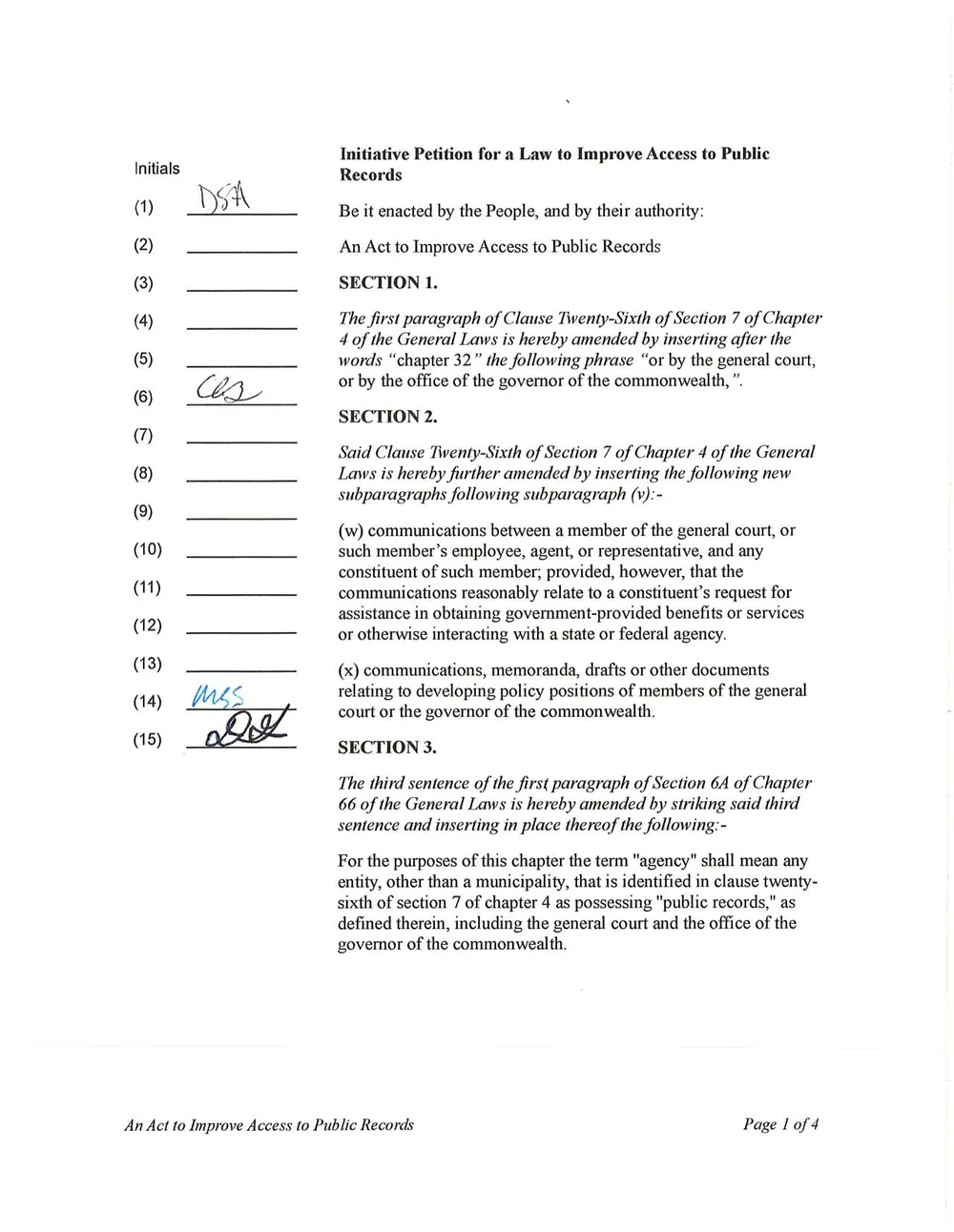
Page 1 of the official AG-certified petition text. View the full PDF on mass.gov
A YES vote ✓ Your choice
Requires the Legislature and the Governor's office to produce records on request, the same as state agencies and cities and towns already must. Three things stay off-limits either way: internal deliberations over policy positions, communications between a legislator's office and a constituent about getting help from government services, and veterans' records. The Legislature is also working on its own bill, and whether it would override this measure is disputed (see the last two questions below).
A NO vote ✓ Your choice
Keeps the current exemption. The Legislature and the Governor's office can still decline to respond to records requests, as they can today. If the Legislature's own bill becomes law, a NO vote would not leave things exactly as they are (see the last two questions below).
Who this affects
- Journalists, researchers, and anyone who requests government records
- State lawmakers and the Governor's office
- State Auditor Diana DiZoglio, who filed the petition
Common questions
If the Legislature has to release records, what happens to constituents' privacy?
Casework correspondence (someone getting help from a legislator's office with, say, unemployment benefits) is carved out, but only when it “reasonably relates” to that assistance. A message that is really about a policy view rather than getting help with a benefit, a service, or dealing with an agency would fall outside that carve-out, and could still be released.
What counts as “developing policy positions”?
The petition exempts “communications, memoranda, drafts or other documents relating to developing policy positions” of legislators or the Governor, and doesn't define the phrase any further. The state's official summary repeats it without narrowing it. That leaves the scope to be settled in practice: by the offices deciding what to release, and by whoever challenges those decisions. Read broadly it could cover most of the deliberation behind a bill; read narrowly, only actual drafting work. Nothing in the petition's text picks between them.
If they ignore my request, what happens?
The same thing that happens now. This measure doesn't change it. Under the existing law a records access officer has 10 business days to respond in writing. If the request is denied, or nothing comes back, you appeal to the Supervisor of Records at the Secretary of the Commonwealth's office, and after that to superior court, which can award attorney's fees. This measure brings the Legislature and the Governor's office under that same process rather than building a new one. Open-government groups have long argued it is weakly enforced. A YES vote widens who the law reaches; it doesn't change how it's enforced.
What about the Legislature's own public records bill?
The House and the Senate have each passed their own version of a public records bill, H.5469. The two versions differ, a conference committee is working on a compromise, and nothing has been signed as of October 7. Both versions work differently from Question 1:
- Both cover the Governor's office. Both also cover the Legislature, but through a separate request process run by the Legislature's own records officers, not through the existing public records law.
- The Legislature would have to release only a listed set of final records. The list has 17 categories in the House version and 19 in the Senate version, and includes things like bills, committee votes, hearing records, journals, financial records and audit reports. Question 1 covers records generally, with three carve-outs.
- Both versions say that process is the “sole and exclusive remedy” for getting records of the Legislature, and that no other law providing public access to records applies to it, including the public records law.
- The House version also limits what the State Auditor can audit at the Legislature and keeps courts out of audit disputes. The Senate version leaves that out.
Could the Legislature's bill override Question 1 if both pass?
That is disputed, and it can't be settled yet because there is no final bill. State Auditor Diana DiZoglio, who filed the petition, says the “sole and exclusive remedy” language is meant to keep Question 1 from applying to the Legislature even if voters approve it. House Speaker Ron Mariano has said his bill will increase access to public records. The conference committee has not reported, and the language could change.
Who's for it, who's against it, and why
Supporters say
The Coalition for Healthy Democracy is leading the campaign, joined by Governor Maura Healey and State Auditor Diana DiZoglio, who filed the petition after a dispute over her authority to audit the Legislature. They point out that Massachusetts is the only state where the Legislature, the courts, and the governor's office are all exempt from the public records law, and argue that exemption should end.
Funding: Three committees are registered in support of Question 1. The Coalition for Healthy Democracy 2026 (the same committee behind Question 3) has reported about $7.71 million in total receipts since it organized in 2025 (one pool of money shared by Questions 1 and 3, not raised only for Question 1), the largest committee on this year's ballot. Top donors: Randy Peeler of Berkshire Partners (about $1 million) and Andrew Balson of Cove Hill Partners (about $790,000). A second committee, the Committee for Transparency and Democracy, has reported about $332,000.
Opponents say
No formal opposition committee has organized. Senate President Karen Spilka has criticized how the measure was drafted, and the broader case against it is the one this question already carves out an exception for: lawmakers say they need room for candid, private negotiation before a bill is final.
Funding: None reported. No committee has registered with to oppose Question 1.
Committee filings at OCPF: Support: Committee for Transparency and Democracy · Coalition for Healthy Democracy 2026 · Democratic Socialists For a Fair Massachusetts
Funding figures are total receipts reported to OCPF since each committee organized, through filings covering the period ending October 26, 2026, checked October 27, 2026. They will shift before Election Day.
How to read these numbers
In-kind support is noted separately where it's significant. Check every figure against OCPF's own ballot-question filings. OCPF's summary view reports money spent, and it splits a committee that works on two questions evenly between them, so its per-question totals are smaller than the receipts shown here. Each committee's own OCPF page shows its receipts.
Official source: Secretary of the Commonwealth, 2026 Information for Voters. The ballot language, official summary, and any fiscal statement come from there. Independent research: background and funding figures compiled by this site from Tufts University's Center for State Policy Analysis and OCPF campaign finance filings. Not an official state source.
Other places to look
No single guide should be your only one. These are worth your time, and a couple of them do things this site can't:
- Information for Voters, the state's "red book". Mailed to every household. It prints the full legal text and the arguments written by the campaigns themselves, which is a primary source no summary replaces. If anything on this site conflicts with it, believe the red book.
- League of Women Voters of Massachusetts. Explainers plus live forums where you can hear the campaigns and ask your own questions. They are nonpartisan on candidates and parties, and they do take positions on some of this year's questions; they say openly which ones.
- Tufts Center for State Policy Analysis. Nonpartisan analysis of what each question would actually do. Takes no positions.
- OCPF campaign finance filings. The raw source behind the funding figures here. Check my numbers against it.
- Ballotpedia. Background and history on each measure.