
Question 4: Election Day Registration
Would let eligible residents register and vote on the same day at their polling place, instead of registering at least 10 days ahead as current law requires. It would take effect January 1, 2028, so it would not apply to this November's election.
Last verified October 27, 2026 against the official guide.
A YES vote: Register and vote the same day at the polls, starting in 2028. A NO vote: Must still register at least 10 days ahead.
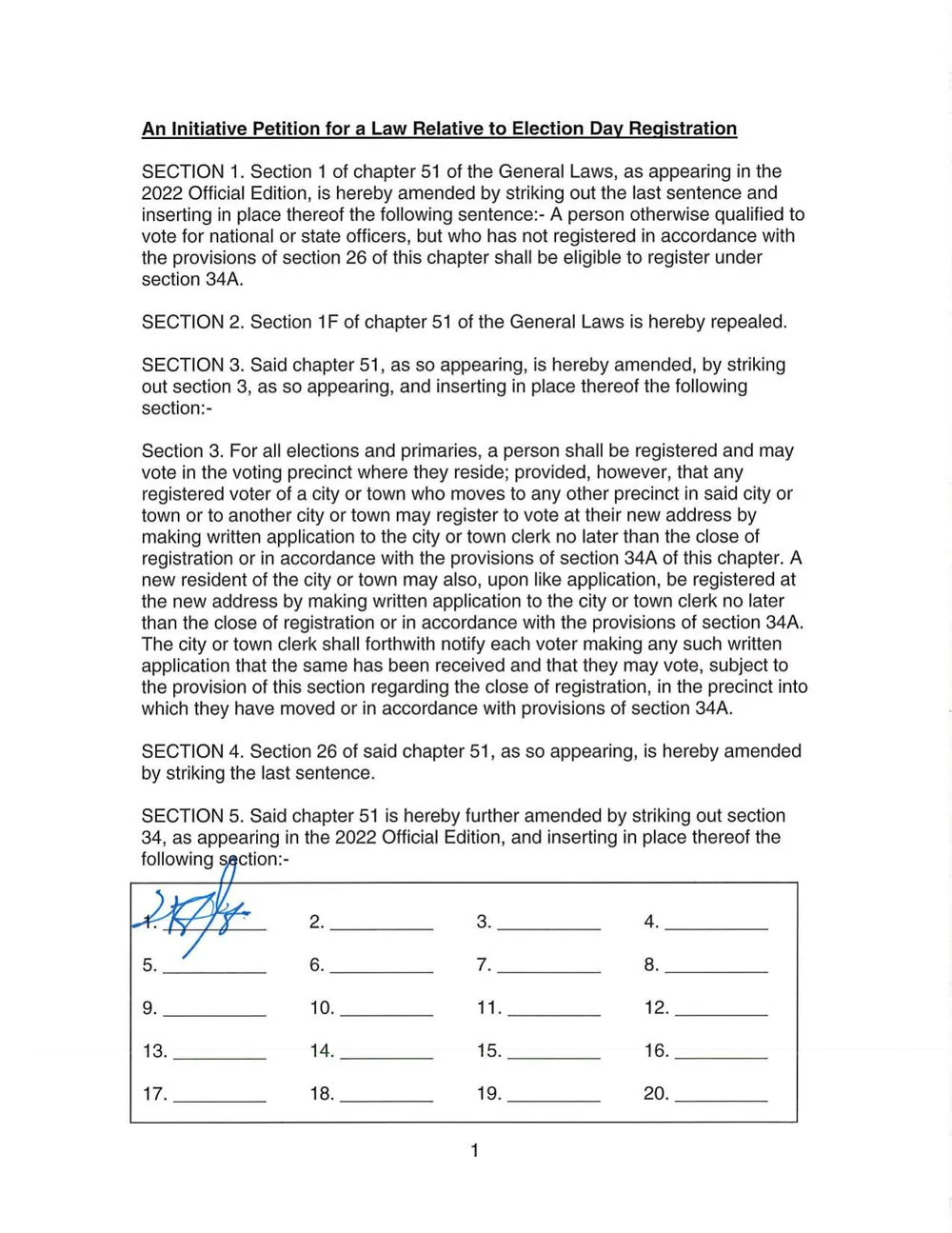
Page 1 of the official AG-certified petition text. View the full PDF on mass.gov
A YES vote ✓ Your choice
Lets eligible residents register at their polling place on election day, by showing proof of residency and signing a sworn statement about citizenship, age, and eligibility. This would take effect January 1, 2028, so it would not change how you register for the November 3, 2026 election. Falsely signing the statement is a felony, punishable by up to 5 years in prison or a $10,000 fine. Someone who can't produce proof of residency could cast a provisional ballot, counted only if they return with the required information. That registration carries forward to future elections. It would not apply to town meetings (regular city and town elections are covered), and voters couldn't switch party enrollment same-day during a primary.
A NO vote ✓ Your choice
Keeps the current requirement to register at least 10 days before an election.
Who this affects
- Unregistered residents, especially people who move often or register late, starting with the 2028 elections, not this one
- Local election clerks, who'd need new same-day processes with no new state funding attached
- Nearly all likely voters are already registered through automatic registration, so the overall effect may be modest
Common questions
When would this actually start?
January 1, 2028. The measure sets that date in its own text, and the state's official summary says the same. So a YES vote this November would not let anyone register at the polls on November 3, 2026. The current rule still applies, and the registration deadline for this election was Saturday, October 24, 2026.
Doesn't same-day registration make it easier to commit voter fraud?
The sworn statement isn't a formality: falsely claiming citizenship, age, or eligibility on it is a felony, punishable by up to 5 years in prison or a $10,000 fine. That's the main safeguard the measure relies on instead of the 10-day waiting period. The measure also uses the same kind of proof of residency and sworn eligibility statement that voters already provide for regular registration.
Does this apply to local elections and town meetings?
Local elections, yes: city and town elections and primaries work the same as state and federal ones under this measure. Town meetings are the one exception: the measure specifically doesn't cover registering in order to vote at an annual or special town meeting, so the 10-day deadline would still apply there.
What if I don't have proof of residency with me?
You could still cast a provisional ballot. It would be counted only if you come back with the required information: before the polls close for a municipal election, within two days after a state primary, or within six days after a state election.
Can I register and switch party enrollment on the same day during a primary?
No. Same-day registrants can't also switch their party enrollment on the spot during a primary election.
Who's for it, who's against it, and why
Supporters say
Secretary of the Commonwealth William Galvin filed the petition after similar bills stalled repeatedly in the Legislature. He's joined by the state Democratic committee and the League of Women Voters of Massachusetts. They point out that 23 states, by the state League's count, already let people register and vote the same day, and say Massachusetts' 10-day cutoff quietly shuts out people who move, turn 18, or don't think about registering until close to the election.
Funding: About $168,000 reported by YES on Election Day Voter Registration since it organized in 2025 (still the least-funded question on this year's ballot), including a $29,000 contribution from Secretary of the Commonwealth William Galvin's own campaign account. A second committee, Vote YES on 4 Election Day Registration, registered in August 2026 and has reported about $153,000 in in-kind support and about $3,000 in cash.
Opponents say
No opposition committee has formed. The Massachusetts Republican Party wrote the official argument against Question 4 in the state's voter guide. It says the 10-day window is when election officials check a new voter's identity, address, eligibility, and whether they're registered somewhere else, and that moving those checks to the polls on Election Day would put workers under time pressure. Mistakes or false statements, it argues, might not come to light until after the ballot has been cast and mixed in with everyone else's, when it can no longer be pulled back.
Funding: None reported. No committee has registered with to oppose Question 4.
Committee filings at OCPF: Support: YES on Election Day Voter Registration · Vote YES on 4 Election Day Registration · Democratic Socialists For a Fair Massachusetts
Funding figures are total receipts reported to OCPF since each committee organized, through filings covering the period ending October 26, 2026, checked October 27, 2026. They will shift before Election Day.
How to read these numbers
In-kind support is noted separately where it's significant. Check every figure against OCPF's own ballot-question filings. OCPF's summary view reports money spent, and it splits a committee that works on two questions evenly between them, so its per-question totals are smaller than the receipts shown here. Each committee's own OCPF page shows its receipts.
Official source: Secretary of the Commonwealth, 2026 Information for Voters. The ballot language, official summary, and any fiscal statement come from there. Independent research: background and funding figures compiled by this site from Tufts University's Center for State Policy Analysis and OCPF campaign finance filings. Not an official state source.
Other places to look
No single guide should be your only one. These are worth your time, and a couple of them do things this site can't:
- Information for Voters, the state's "red book". Mailed to every household. It prints the full legal text and the arguments written by the campaigns themselves, which is a primary source no summary replaces. If anything on this site conflicts with it, believe the red book.
- League of Women Voters of Massachusetts. Explainers plus live forums where you can hear the campaigns and ask your own questions. They are nonpartisan on candidates and parties, and they do take positions on some of this year's questions; they say openly which ones.
- Tufts Center for State Policy Analysis. Nonpartisan analysis of what each question would actually do. Takes no positions.
- OCPF campaign finance filings. The raw source behind the funding figures here. Check my numbers against it.
- Ballotpedia. Background and history on each measure.