
Question 3: State Primary Elections
Would replace separate party primaries with a single primary where every candidate appears on one ballot and the top two advance, regardless of party. Supporters call it more voter choice; the opposition is unusual, including both the state parties and some progressive groups. It would take effect January 1, 2028, so it would not apply to this November's election.
Last verified October 27, 2026 against the official guide.
A YES vote: One combined primary; top two advance regardless of party. A NO vote: Separate party primaries stay as they are.
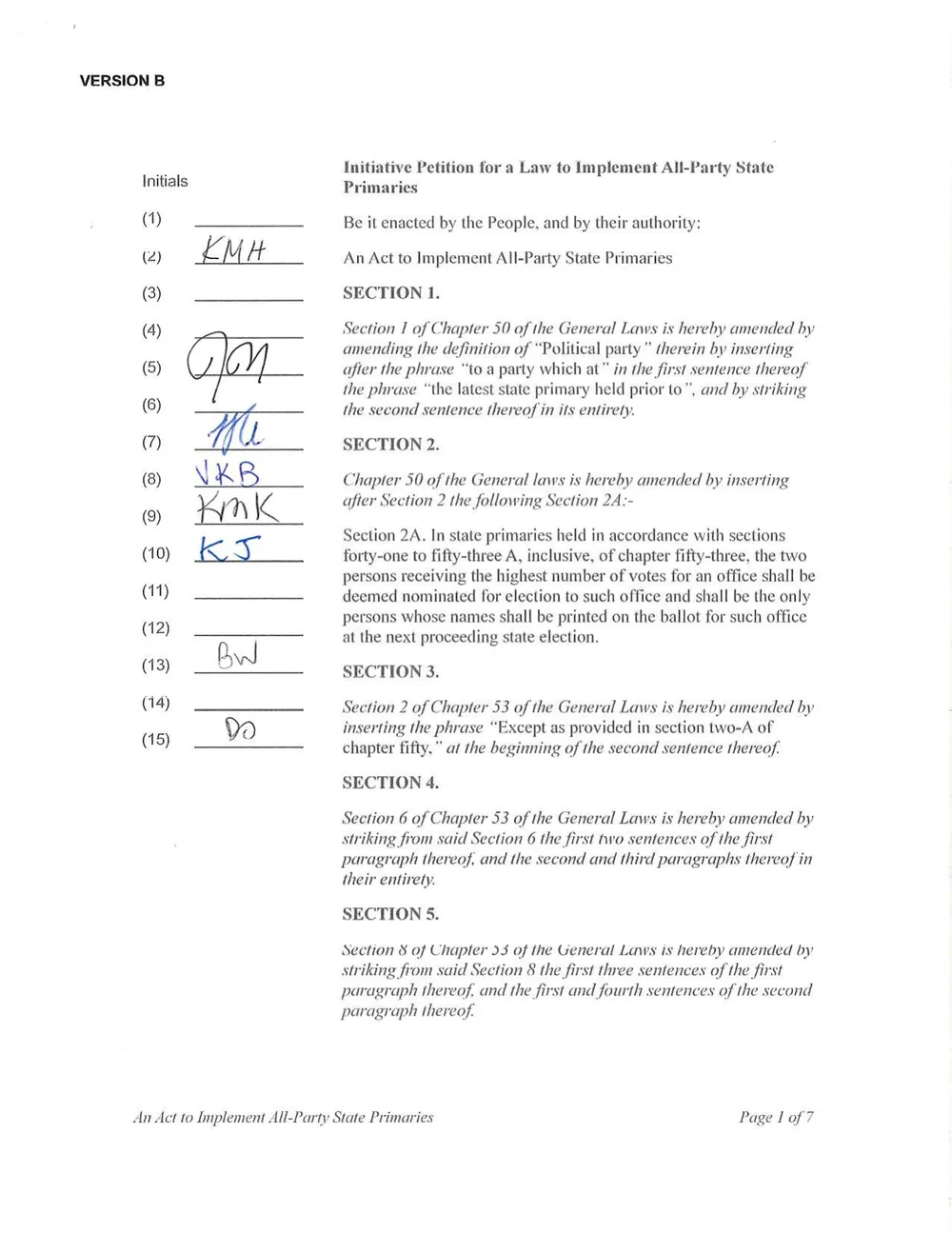
Page 1 of the official AG-certified petition text. View the full PDF on mass.gov
A YES vote ✓ Your choice
Creates a single primary for state offices (governor, other constitutional offices, U.S. Senate and House, state Legislature, district attorney, sheriff) where every candidate appears on one ballot and every registered voter gets the same ballot. The top two vote-getters move on to the general election, even if they belong to the same party. Governor and lieutenant governor would run as a joint ticket. Each candidate's party would still be listed on the ballot. It would also grant official political party status to any group whose candidates for a statewide office win at least 3% of the ballots cast in the state primary. It would take effect January 1, 2028, so it would not change this November's election. It does not apply to presidential primaries or to city and town elections.
A NO vote ✓ Your choice
Keeps separate party primaries as they work today.
Who this affects
- Every registered voter, especially unenrolled (independent) voters who can already vote in either party's primary
- Candidates and the state's political parties, which would lose control over nominations
- Third parties, which could gain official party status by clearing 3% in the state primary
- Congressional and state legislative races
Common questions
Doesn't this just give independents more say?
Not exactly: Massachusetts already lets unenrolled (independent) voters, the actual majority of the electorate, choose which party's primary to vote in each cycle.
What would this mean for third parties?
The measure would give official political party status to any group whose candidates for a statewide office receive at least 3% of the ballots cast in the state primary. That's a separate route to party status from the one in current law, and it's the provision most directly relevant to smaller parties.
Why are progressive groups opposing this alongside the parties and unions?
Their objection is different from the parties'. Groups like Act on Mass and Progressive Mass argue that today's system isn't great, but a combined primary could reward whoever raises money fastest in a crowded field, which is worse for grassroots campaigns, not better.
Is there a cheaper alternative that solves the same problem?
Some critics argue ranked-choice voting achieves similar goals without the cost and access trade-offs opponents attribute to top-two primaries.
Both sides point to California's primary system, so what does its experience actually show?
Supporters cite California, along with Washington and Nebraska, as a working model for a combined primary. Opponents point to that same state as evidence that combined primaries make statewide campaigns more expensive to run, favoring self-funded or well-connected candidates. Both sides are reading the same example differently: it's a real disagreement about what California's experience proves, not a factual dispute.
Could a party's vote split so badly that none of its candidates advance?
It has happened. In California's 31st congressional district in 2012, a district Barack Obama had carried 58 to 42 four years earlier, four Democrats divided their party's primary vote while two Republicans finished first and second, so no Democrat appeared on the general election ballot. The mechanism is worth stating precisely: Republicans out-polled Democrats in that low turnout primary, 51.5 percent to 48.5 percent combined, and the split turned that narrow edge into both general election slots. Supporters of Question 3 would say the fix is for voters and parties to consolidate behind fewer candidates, which is largely what happened in California afterward. Opponents say that needing that coordination is itself the problem.
Who's for it, who's against it, and why
Supporters say
The Coalition for Healthy Democracy, the same group behind Question 1, sponsored the petition. Supporters include U.S. Representatives Jake Auchincloss and Seth Moulton, and former Governors Deval Patrick, a Democrat, and Charlie Baker, a Republican. Baker endorsed it on October 5. They point to a simple number: roughly two-thirds of Massachusetts voters aren't enrolled in either party, and say a combined primary would give them more real say over who ends up on the general-election ballot, following a model already used in California, Washington, and Nebraska.
Funding: About $7.71 million in total receipts through the Coalition for Healthy Democracy 2026 (one pool of money shared by Questions 1 and 3, not raised only for Question 3), the largest committee on this year's ballot. It has reported about $6.9 million in spending across the two questions.
Opponents say
Voter Rights MA is leading the opposition, backed by both major state political parties, Senator Edward Markey, and several large unions. Led by Jordan Berg Powers, they argue combined primaries make campaigns more expensive to run statewide, pointing to California's experience, and say that favors self-funded and well-connected candidates over teachers, social workers, and others without wealthy networks. They'd rather see ranked-choice voting, and note unenrolled voters can already choose either party's primary today. A separate concern, not part of the organized opposition's case: in a crowded field one party's vote can divide among several candidates while another party's consolidates, so the top two may not reflect how the district votes in November.
Funding: About $288,000, nearly all of it through Voter Rights MA, which registered in May 2026, plus about $29,000 in in-kind support. Most of that arrived in the final weeks: its largest donors are the 1199 SEIU Massachusetts PAC at $100,000, the Massachusetts Teachers Association at $90,000 and the Massachusetts Democratic State Committee at $50,000.
Committee filings at : Support: Coalition for Healthy Democracy 2026Oppose: Voter Rights MA · Democratic Socialists Against Reactionary Rollbacks
Funding figures are total receipts reported to OCPF since each committee organized, through filings covering the period ending October 26, 2026, checked October 27, 2026. They will shift before Election Day.
How to read these numbers
In-kind support is noted separately where it's significant. Check every figure against OCPF's own ballot-question filings. OCPF's summary view reports money spent, and it splits a committee that works on two questions evenly between them, so its per-question totals are smaller than the receipts shown here. Each committee's own OCPF page shows its receipts.
Official source: Secretary of the Commonwealth, 2026 Information for Voters. The ballot language, official summary, and any fiscal statement come from there. Independent research: background and funding figures compiled by this site from Tufts University's Center for State Policy Analysis and OCPF campaign finance filings. Not an official state source.
Other places to look
No single guide should be your only one. These are worth your time, and a couple of them do things this site can't:
- Information for Voters, the state's "red book". Mailed to every household. It prints the full legal text and the arguments written by the campaigns themselves, which is a primary source no summary replaces. If anything on this site conflicts with it, believe the red book.
- League of Women Voters of Massachusetts. Explainers plus live forums where you can hear the campaigns and ask your own questions. They are nonpartisan on candidates and parties, and they do take positions on some of this year's questions; they say openly which ones.
- Tufts Center for State Policy Analysis. Nonpartisan analysis of what each question would actually do. Takes no positions.
- OCPF campaign finance filings. The raw source behind the funding figures here. Check my numbers against it.
- Ballotpedia. Background and history on each measure.