
Question 8: Ban on Retail Marijuana Sales
Would repeal the 2016 law that legalized recreational marijuana sales, ending the state's retail cannabis industry while keeping small-amount possession legal.
Last verified October 27, 2026 against the official guide.
A YES vote: Recreational marijuana sales and home growing become illegal again. A NO vote: The legal retail market stays as it is.
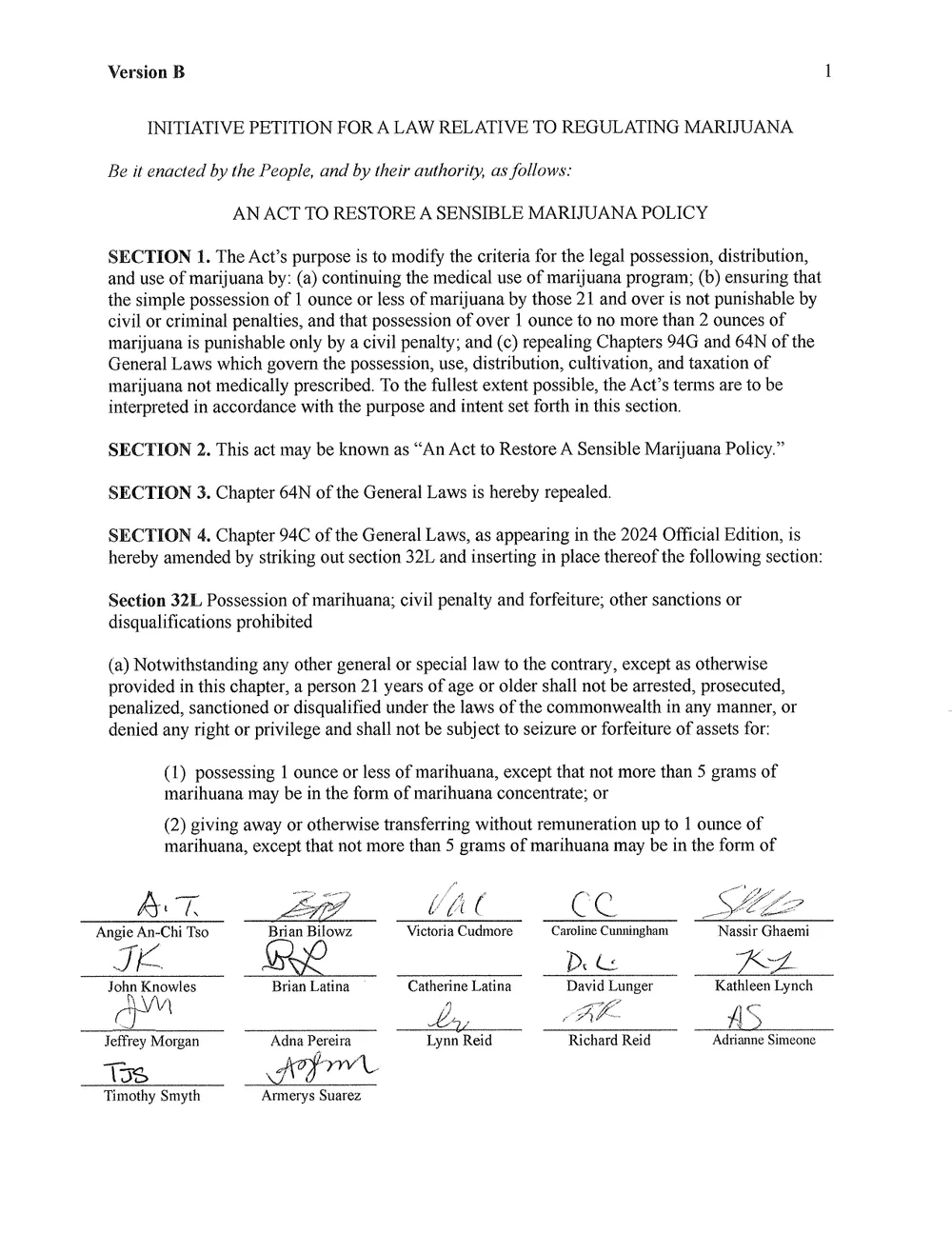
Page 1 of the official AG-certified petition text. View the full PDF on mass.gov
A YES vote ✓ Your choice
Repeals the laws that allow recreational marijuana to be sold, taxed, regulated, and grown at home in Massachusetts. Adults 21 and older could still possess up to one ounce without penalty; possessing one to two ounces (or up to two ounces if under 21) would carry a civil fine instead of jail time. The Cannabis Control Commission would continue regulating medical marijuana only. If it passes, Massachusetts would be the first state to unwind a voter-approved legalization law.
A NO vote ✓ Your choice
Keeps the current legal retail marijuana market and home cultivation rules in place, as they've operated since voters passed legalization in 2016.
Who this affects
- Adult-use cannabis customers
- Licensed dispensaries and their employees, who would lose their business
- Cities and towns that currently collect cannabis tax revenue
Common questions
Would this affect people who already have small amounts of marijuana?
Up to 1 ounce, no. Today adults 21 and over can have up to 2 ounces (a 2026 state law raised the limit from 1 ounce). Under Question 8, up to 1 ounce would still carry no penalty, but more than 1 ounce up to 2 would bring a $100 civil fine and forfeiture instead of jail. Adults could still give away up to 1 ounce to another adult if it isn't advertised.
Could I still grow my own?
Not for recreational use. The right to grow at home sits in Chapter 94G, section 7 of state law (up to 6 plants per adult and 12 per household, in your primary residence), and section 6 of this petition repeals Chapter 94G outright. Medical patients are a separate case: the measure keeps the medical program, and a registered patient who qualifies for a hardship cultivation registration could still grow a limited number of plants. One wrinkle worth knowing, because it cuts the other way: the petition also tells the Cannabis Control Commission to write guidelines on growing marijuana in a primary residence, which reads at first like home growing survives. That instruction sits in the measure's amendments to the medical marijuana chapter and points back to the medical hardship provision, so it appears to be about patients rather than the general public. The state's official summary describes this measure as ending retail sale and changing possession penalties, and doesn't mention home growing either way.
What happens to medical marijuana patients?
The medical program continues, and this measure sets no limits on what patients can buy. That's worth stating plainly, because the opposite has been circulating: potency caps of 30% THC for flower, 60% for concentrates and 5mg per serving. Those caps are real, but they belong to Version A of this petition (25-09), a version that was certified but did not advance to the ballot. The measure on your ballot is Version B (25-10), and it contains no potency language at all. What would change for patients is the retail landscape: stores serving both markets would have to convert to medical-only or close.
Has any other state ever repealed a voter-approved legalization law?
No. If this passes, Massachusetts would be the first state in the country to unwind marijuana legalization after voters approved it.
If retail sales are banned, wouldn't people just buy from the unregulated market instead?
That's opponents' central argument: banning licensed retail would push buyers back to an unregulated market with no age checks or product testing, undoing the regulated system voters approved in 2016. Supporters counter that the public-health cost of today's high-potency legal products, especially youth access, outweighs those risks. Neither side offers a hard estimate of how many buyers would actually shift to the illegal market.
If it passes, how long do stores have to shut down?
The repeal takes effect January 1, 2028, about 14 months after the election. The petition sets no separate wind-down schedule, transition period, or grace period: Section 1 repeals the retail marijuana law and Section 10 makes that effective January 1, 2028. The one accommodation is Section 8, which directs the Cannabis Control Commission to “expedite and streamline” the process for existing adult-use licensees to get medical marijuana licenses instead. So a licensed store's realistic options are to convert to medical or close by that date. Section 8 also lets stores sell their remaining adult-use inventory to medical marijuana dispensaries. The petition doesn't address license fees already paid or employees. Those would be left to the Legislature or the Commission to sort out.
What would this do to city and town budgets?
It would end municipal cannabis revenue entirely. Cities and towns that host a dispensary can currently charge a local tax of up to 3% of retail sales, and can collect a community impact fee on top of that. Both come from the two chapters of law this measure repeals, so both would disappear along with the retail market. In fiscal year 2025 alone, the state's official fiscal statement puts adult-use marijuana taxes at about $280 million in state revenue and $50 million in local revenue. Over time, municipalities have collected roughly $196 million from the local 3% tax since it began (through August 2025), on more than $8 billion in adult-use sales statewide. That's a cumulative total, not a yearly figure. It's concentrated rather than spread evenly: Boston, Worcester, Fall River, Northampton, and Great Barrington collect the most, and a town with no dispensary collects nothing either way. Community impact fees peaked in 2022 and have fallen sharply since a 2022 law required them to be tied to documented costs.
Who's for it, who's against it, and why
Supporters say
The Coalition for a Healthy Massachusetts sponsored the petition, aligned with the national group Smart Approaches to Marijuana. They argue legal retail marijuana has made a far more potent product widely available, including to young people, and say the public-health cost outweighs the tax revenue and jobs the industry brings, while stressing that simple possession would stay legal either way.
Funding: About $3.78 million through the Coalition for a Healthy Massachusetts, funded by its national backer SAM Action Inc. (a Virginia nonprofit that doesn't disclose its own donors), which is nearly all of the YES side's money.
Opponents say
Stop the Repeal, run through the Committee to Protect Cannabis Regulation, leads the opposition, joined by cannabis industry and retail groups. They argue repeal would wipe out an already-regulated, tax-paying industry and its jobs, push buyers back to an unregulated market with no age checks or product testing, and reverse a law voters approved themselves in 2016, all without addressing youth access, which they say mostly comes from that unregulated market, not licensed stores.
Funding: About $2.96 million across four committees opposing the repeal, nearly all of it through the Committee to Protect Cannabis Regulation and including $100,000 from the Retailers Association of Massachusetts, plus about $185,000 in in-kind support. The newest of the four, the Coalition for Responsible Cannabis Policy, registered in September 2026 and has reported about $150,000, nearly all of it from one donor, Todd Stiefel.
Committee filings at : Support: Coalition for a Healthy Massachusetts, Inc.Oppose: Committee to Protect Cannabis Regulation · Committee for Keep Cannabis Legal, Vote No on 8 · Democratic Socialists Against Reactionary Rollbacks · Coalition for Responsible Cannabis Policy
Funding figures are total receipts reported to OCPF since each committee organized, through filings covering the period ending October 26, 2026, checked October 27, 2026. They will shift before Election Day.
How to read these numbers
In-kind support is noted separately where it's significant. Check every figure against OCPF's own ballot-question filings. OCPF's summary view reports money spent, and it splits a committee that works on two questions evenly between them, so its per-question totals are smaller than the receipts shown here. Each committee's own OCPF page shows its receipts.
Official source: Secretary of the Commonwealth, 2026 Information for Voters. The ballot language, official summary, and any fiscal statement come from there. Independent research: background and funding figures compiled by this site from Tufts University's Center for State Policy Analysis and OCPF campaign finance filings. Not an official state source.
Other places to look
No single guide should be your only one. These are worth your time, and a couple of them do things this site can't:
- Information for Voters, the state's "red book". Mailed to every household. It prints the full legal text and the arguments written by the campaigns themselves, which is a primary source no summary replaces. If anything on this site conflicts with it, believe the red book.
- League of Women Voters of Massachusetts. Explainers plus live forums where you can hear the campaigns and ask your own questions. They are nonpartisan on candidates and parties, and they do take positions on some of this year's questions; they say openly which ones.
- Tufts Center for State Policy Analysis. Nonpartisan analysis of what each question would actually do. Takes no positions.
- OCPF campaign finance filings. The raw source behind the funding figures here. Check my numbers against it.
- Ballotpedia. Background and history on each measure.